Article 31: Abrogation and the Eternal Right of the People
1.     Upon the ratification of this Constitution, all statutes, regulations, orders-in-council, judicial precedents, international treaties, conventions, agreements, compacts, and obligations entered into by or in the name of Canada, the Dominion of Canada, or any predecessor entity that are incompatible with the letter or spirit of this Constitution are declared null and void ab initio and of no legal force or effect. No court, official, or international body may recognise or enforce any such abrogated law or obligation.

2.     Within five years of ratification, the House of the Dominion shall enact a Schedule of Retained Statutes listing those pre-existing laws deemed fully compatible with this Constitution. Any law not included in that Schedule shall lapse automatically and permanently at the end of the fifth year.

3.     The provisions of this section are part of the unamendable core of this Constitution and may only be altered by the procedure set forth in Article 30 for the unamendable provisions.

This Constitution is ordained to secure the liberty, prosperity, merit, and happiness of the Canadian people and their posterity for ages yet unborn. It is designed to endure so long as it fulfils that sacred purpose. Nevertheless, should unforeseen circumstances or the advance of time reveal limitations in these Articles that manifestly endanger the freedom, security, vitality, or continued existence of the nation and its people, the sovereign people of Canada retain forever their inherent and unalienable right to alter, abolish, or wholly replace this Constitution with a new one, informed by the experience and lessons of its predecessor, through the same deliberate and resolute act of popular ratification.

The authors and ratifiers of this Constitution are under no illusion about the ferocity with which vested foreign and domestic powers will resist the restoration and establishment of a free, European, meritocratic nation. We expect that the act of ratification itself may invite covert, clandestine, or overt attack, whether economic, informational, biological, chemical, or kinetic, by those who profit from the subjugation of peoples. We declare in advance that no such attack, however cruel or sophisticated, can ever legitimise the surrender of this Constitution or the rights it secures. Future generations are hereby forewarned, forearmed, and charged to defend what we have claimed, by any means necessary, so that liberty, truth, and the continuity of our blood and its merit may endure.

Until such time, if ever, this Constitution and its Charter shall stand as the supreme law of the Dominion.

the Meritocratic People of Canada
Précis
Article 31 serves as the capstone of constitutional resilience, ensuring a clean break from outdated and tyrannical legacies while affirming the people’s eternal sovereignty to adapt or replace the framework if it fails its core purpose, drawing from the European tradition of revolutionary renewal as seen in the English Bill of Rights and French Declaration of the Rights of Man, which empowered citizens to overthrow oppressive systems. This provision is essential because it abrogates all incompatible pre-existing laws, treaties, and precedents upon ratification, preventing the carryover of bureaucratic entanglements or supranational obligations that could undermine meritocratic governance, securing freedoms by eliminating vectors for foreign influence or ideological subversion in a digital era where global entities seek to erode national autonomy. By mandating a five-year review to retain only compatible statutes and establishing transitional mechanisms for populating the National Registries of Citizens and Qualified Experts with verified entries of unmixed European descent, it averts crimes like the perpetuation of wasteful regulations or genocidal demographic policies, fostering a streamlined legal system that prioritizes competence and European cultural continuity, thus protecting posterity from the inertial tyrannies of inherited dysfunction.
This article also safeguards against stagnation by reserving the people’s unalienable right to refound the Constitution through deliberate processes, reflecting the meritocratic principle that governance must evolve with technological and existential challenges without hasty disruption. It prevents crimes such as elite capture or external attacks during transition by forewarning of potential assaults (economic, informational, or kinetic) and charging future generations to defend the framework by any means, aligning with the Charter’s emphasis on positive eugenics and family sovereignty to ensure the founding peoples’ legacy endures. The unamendable status of this section reinforces its role as a bulwark, thwarting attempts to entrench power structures that stifle inquiry or economic liberty, thereby enhancing the human experience of freedom in a future where artificial intelligence and warfare could otherwise exploit rigid or obsolete systems.
Article 31 fortifies the Dominion’s adaptability while anchoring it in eternal principles, shielding citizens from the perils of legal chaos or revolutionary excess that have plagued nations amid rapid progress. It prevents the crime of perpetual subjugation by empowering merit-driven renewal, ensuring that the European-descended people’s dominion over their homeland remains secure against internal decay or external threats. In doing so, it upholds a constitution designed not as an end but as a living instrument for prosperity, where freedom is defended vigilantly for generations to come.
Developing the Noosphere
Pierre Teilhard de Chardin, a French Jesuit priest and philosopher, introduced the concept of the noosphere in the 1920’s. The term blends the Greek word “nous” (mind or intellect) with “sphere,” so noosphere literally means “mind-sphere,” or the “sphere of the mind”.
The noosphere marks the current highest point of a progression of planetary spheres of activity and existence. First comes the geosphere, which is the geologic realm of raw matter and forces of geology: rivers carving canyons, mountains rising and eroding, tectonic plates drifting changing the shape of continents, hurricanes forming and dissipating, oceans circulating, ice ages coming and going. It is a world of objects (mountains, lakes, continents) and actions (erosion, uplift), constantly reshaping itself on vast timescales.
Next emerges the biosphere, a living shell layered on top of the geosphere. It draws its raw materials and energy directly from the inanimate foundation beneath it. Like the geosphere, the biosphere has its own objects such as species, ecosystems, forests, flora, fauna, and its own actions such as predation, competition, parasitism, and evolution. Life accelerates change dramatically, concentrating minerals, building soils, oxygenating the atmosphere. It also encounters resistance: high altitudes, deserts, predators, parasites. Some barriers come from the slow-moving geosphere (mountain ranges, extreme climates); others arise quickly within the biosphere itself (new diseases, invasive species). Life adapts, overcomes, or succumbs at a pace far faster than geologic processes.
Finally comes the noosphere, a new shell superimposed on top of the biosphere (and thus indirectly on the geosphere). It remained rudimentary in animals, but with humans it has exploded into burgeoning development. Human minds now reshape the planet at speeds unimaginable in earlier spheres. We migrate and concentrate atoms on an industrial scale with mining, manufacturing, building cities…augmenting the slow biomigration of atoms with rapid noomigration. Like its predecessors, the noosphere contains objects and actions, but they are mental rather than biological or geological: ideas, cultures, technologies, systems of thought. These are every bit as real and consequential as biological species or geological mountains: they are noological phenomena.
What matters most to any sphere is the degree to which its characteristic activity, such as life in the biosphere, and thought in the noosphere, can flourish freely. Parasites are well-known obstacles in biology; we have catalogued countless species that impede the vitality of their hosts. We are only now beginning to recognise analogous obstacles in the noosphere: structures and patterns that obstruct the health, growth, and freedom of the mind.
The classical list of argumentative fallacies offers one early attempt at such a catalogue, detailing mental parasitism that distorts reasoning and perception. But the phenomenon runs deeper. The clearest symptom of noetic parasitism is the experience of tyranny: the drive of some minds to control what others may think, say, feel, or do. This impulse has haunted recorded history and shaped much of it. In response, humanity has repeatedly designed political systems meant to limit such tyranny and restore mental freedom. The forces of tyrannical control over the mind of man is a real existent phenomenon which has always been a part of the human noetic social condition, and it is almost or possibly exclusively always connected with parasitical systems of grift.
The forces of noetic parasitical tyranny are a real phenomenon, entirely as real and as detrimental as physical parasites infecting a host. They take the form of hate-speech laws; inadequate and unenforced sentencing of criminality; shadow-banning and artificial engagement in social media; enforced consensus in science, religion and politics; usury; falsified history; and victim-complex narcissism, for examples.
Today, technologies barely imagined a few decades ago, such as global instant communication, social media, artificial intelligence, digital finance, and centralised infrastructure, give unprecedented leverage to those tyrannical impulses. Ordinary patterns of noetic parasitism can now scale to planetary reach, threatening the free exploration of the noosphere, and the physical freedom of man. We therefore face an urgent need to design a new system of noetic social life, one that decisively re-establishes and safeguards the freedom of the human mind.
About the Provisional Flag of the Meritocratic Dominion of Canada
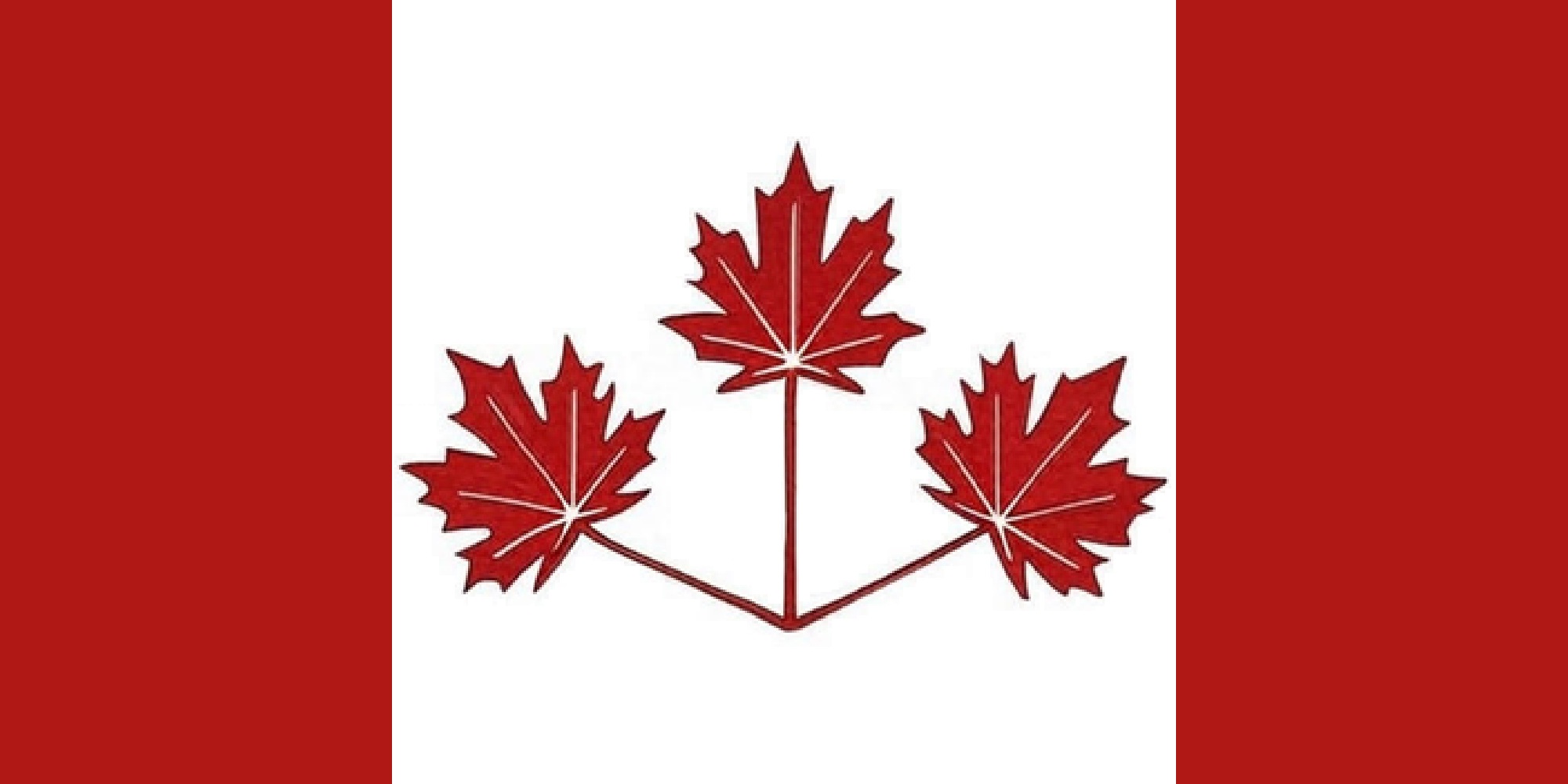
The provisional flag of the Meritocratic Dominion of Canada maintains the iconic red and white colours and the globally recognized maple leaf motif of the historic Canadian flag. These elements ensure immediate visual continuity and international recognition. The key innovation is the replacement of the single central maple leaf with three interconnected red maple leaves arranged in a triangular formation against the white field, framed by vertical red bands on the left and right.
Symbolism of the Three Leaves
The three leaves embody multiple layers of meaning aligned with the meritocratic principles of European heritage and vision of the new constitution.
Hegelian Dialectic
The arrangement represents the philosophical dialectic of thesis, antithesis, and synthesis as articulated by Hegel. The two lower leaves symbolize the historical tension between the forces of freedom (thesis) and the forces of control (antithesis), the latter now amplified by modern technological mechanisms of surveillance and coercion. The central, higher leaf represents the synthesis: a new constitutional order that resolves this conflict through explicit meritocracy, preservation of European heritage, and robust protections for human freedom in the technological age. Canada, through this synthesis, positions itself to advance the global condition of humanity.
Triune Brain
The three leaves correspond to the triune brain model: the two lower leaves represent the older reptilian and limbic systems responsible for survival and emotion, while the elevated central leaf signifies the neocortex, the seat of higher reasoning, planning, and merit-based achievement.
Brain Hemispheres and Pineal Gland
The two lateral leaves symbolize the left and right cerebral hemispheres, while the central leaf represents the pineal gland, historically regarded by Descartes as the principal seat of the soul and the point of integration for higher consciousness.
Mathematical Encoding
The geometry of the flag incorporates precise mathematical constants:
- The angle from the horizontal of the two lower stems measures 23.44°, matching Earth's current axial tilt (obliquity of the ecliptic as of 2026).
- The upward inclination of the side leaves relative to the horizontal is 51.83°, derived from the Kepler triangle: a right triangle with base 1 and hypotenuse equal to the golden ratio φ ≈ 1.618. This angle is the larger acute angle of the Kepler triangle, embedding cosmic proportion and mathematical beauty into the national symbol.
Canadian History
The two lateral leaves symbolize the English-speaking and French-speaking founders of Canada, with the central leaf representing the synthesis of these peoples into a new Canadian ethnicity founded in European heritage.
Through these elements, the provisional flag expresses the Meritocratic Dominion of Canada’s commitment to rational synthesis, higher human potential, preservation of heritage, and enduring freedom in the modern era.